 |
|
| TIPS and DRILLS |
| Against-the-wall handstands |
| Purpose: To help you achieve the control and balance necessary to do a handstand. |
| Procedure |
| 1) Kick up to a handstand so that your back and feet are touching the wall. |
|
||||
| 2) Hold the handstand against the wall for 15 seconds. |
| 3) Repeat five to 10 times. |
| 3) Add five seconds every third day. |
| 4) Once you get to 30 seconds, start doing handstands on the floor with a spotter. |
| Key points |
|
Moving your hands closer to the wall will enable you to be more dependent on the strength of your arms. | |
|
Your hands should not be wider or narrower than the width of your shoulders. | |
|
Keep your head neutral. Forward tucking will cause your back to round, and backward arching will cause your back to arch. | |
|
Your entire body should be tight and straight. | |
| Pogo stick |
| Purpose: To teach the proper body form for a standing back tuck. |
| Procedure |
| 1) Stand on a folded panel mat. |
|
||||
| 2) Repeatedly jump as high as you can, going backwards and landing just beyond the mat. |
| 3) Look for a focus point as you are jumping. |
| Key point |
|
At the top of the jump, your arms should be by your ears -- this is how you set for the tuck back. | |
|
If you don't see your focus point as you jump, you are probably throwing your head back. | |
|
If you need to increase the height of your jump, you may need to focus on some leg muscle conditioning. | |
| London Bridge back walkovers |
| Purpose: To help you do a back walkover. |
| Procedure |
| 1) Start in a standing position on a slightly elevated surface (i.e. a panel mat). |
|
||||
| 2) Do a back walkover, completing several repetitions of kicking over until you are able to do it from floor level. |
| 3) Next, from a standing position, arch over backwards until your hands meet the floor. |
| 4) Have a spotter place a hand on your back to help you ease into the arch. |
| 5) Once you get into the bridge position, kick over. |
| Key point |
|
If your front leg on a cartwheel is your right leg, then your right leg should be the leading leg on your walkover. | |
|
When doing the backwards movement, be sure to keep your arms straight and next to your ears so you don't hit your head. | |
|
Once you start doing this move on the floor, gradually move your front leg farther and farther in front of your standing leg until you are able to have all your weight on one leg. | |
| >>>>>>>>>>>>>>>>>>>>>>>>>>>>>>>>>>>>>>>>>>>>>>>>>>>>>>> |
 NEW SPARK BELOW.............
 |
| Basic skills |
|
To overcome the fear of falling over while kicking up into a handstand, remember you can safely "bail out" by doing a forward roll out of the handstand or doing a quarter twist and stepping down. To make twisting a more efficient movement, squeeze your body so that it turns as a whole. This helps you to conserve your momentum into the turn. | |
|
To make turning or twisting easier, pull your arms closer to your body. This will shorten your turning radius and make it easier to turn. | |
|
The abdominals are some of the most important muscles in the body for gymnastics and many other sports. Having strong abs is crucial to being successful in many skills, or just maintaining form in most skills. | |
|
Fear is always a component that confronts all gymnastic coaches. One of the ways for gymnasts to overcome fear of bars is to have them swing and train in the "safest" environment possible. Pit bars are wonderful, or raise the bars and put soft landing mats under the bars and let the gymnast swing by himself or herself. | |
|
||
| Rhythmic gymnastic training will improve your floor exercise. It develops gymnasts' grace, dance techniques, balance and definitely increases their range of motion. |
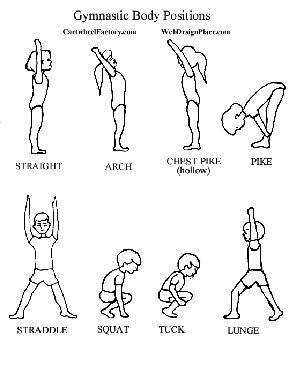 |
| GYMNASTIC POSITIONS |
| <<<<<<<<<<<<<<<<<<<<<<<<<<<<<<<<<<<<<<<<<<<<< |
| PRACTICE the BODY POSITIONS by doing an activity called |
| DO THIS , DO THAT . Have the students go throught he positions but only after you say DO THIS . IF the teacher says DO THAT then all must stay frozen . Change swiftly for following directions and attention to detail and form. |
| >>>>>>>>>>>>>>>>>>>>>>>>>>>>>>>>>>>>>>>>>>>>>>>> |
| Rhythmic gymnastics is a sport with lot of elements taken from gymnastics |
| and from dance. Ballet is involved too. For good gymnasts it is important to |
| be very flexible, and coordinative. But our kids in schools are just |
| average, and that is why I will write about basic skills. |
| Rhythmic gymnastics has 4 main movement groups or movement concepts: |
| 1. Jumps and leaps |
| 2. Balances |
| 3. Turns and pivots |
| 4. Flexibility movements and body waves |
| With each group of movement concepts it is possible to do basic hoop skills: |
| 1. Tossing and catching: |
| -toss with one hand vertically from the side of the body and toss in |
| front of the body( the beginning posture for the last toss is: holding hoop |
| with both hands in front of the body, then toss the hoop sideways up and |
| catch with the other hand) |
| - horizontally toss with both hands, hoop spins around its |
| horizontal axis and catch |
| - toss and catch with foot and hand at the same time (vertically |
| toss) |
| - toss and catch with one hand behind the back and with other hand |
| over the hoop |
| - hoop vertically on the floor, one foot stepped at the hoop, toss |
| hoop with the leg performing a back scale |
| 2. Hoop circles |
| - Hoop placed on hand , swing the hoop in circular pattern (hold |
| thumb on one side and all four others fingers on the other side of hoop, so |
| the hoop will not flip out of hand) |
| - Circle the hoop : a) frontal to the right and to the left side, |
| exchange the hands too |
| b) sagittal to the back and to the |
| front, try it with each hand |
| c) horizontal with the right hand circle |
| first to the left side, the same with the left hand circle to the |
| right side |
| d) the same as c) but exchange the hands |
| in the middle of the movement and turn the hoop around |
| legs. The same circling and hands exchanging is possible to do above head. |
| 3. Hoop spin - turning the hoop around its vertical axis. Can be |
| performed on the floor or around the hand, like twirl. |
| 4. Hoop roll - a roll in which the hoop rolls on the ground or on the |
| body. |
| - boomerang roll -the student rolls the hoop |
| forward along the ground imparting a strong backspin to the |
| hoop causing it to roll back to the student. |
| -circular hoop roll - a roll with hoop tilted |
| causing the hoop to roll along a curved path. |
| 5. Turn of the hoop - hoop circles executed with both hands grip of the |
| hoop above head (frontal axis). A full turn of the hoop requires the student |
| to jump over the hoop. Direction of the hoop could be forward or backward turn . |
| When you get your student pretty skilled, you could choreograph a routine |
| with music. |

|
| NEW SKILL OF THE MONTH : |
| HANDSTAND |
| <>Characteristics: 1. Shoulders should be fully extended |
| 2. The shoulder to torso angle should be extended |
| 3. The back should be extended |
| 4. Arms should be straight |
| DIFFERENT HANDSTANDS: |
| 1. Straight handstand - natural head position , hips flat , It should look like a long straight line. |
| 2. Bar handstand - for giants , clear hips and after a cast |
| 3. Balancing handstand - for floor , beam . Focus should be on hands , which should be palms flat and fingers spread and curled to floor. |
| DRILLS: 1. Just lying on the floor on the stomach and back |
| 2. Minitramp bouncing - try to be straight and maintain a correct body position |
| 3. Wall walk - hands on the ground , feet against the base of the wall. Begin to walk up wall , stomach facing the wall - rounded back and extend shoulders |
| Drills for Power Hurdle with Legs Together Step Out By Vladimir Artemov, USA Gymnastics Women's Program National Team Staff Member |
| Having a powerful hurdle is so important to becoming a great tumbler. Here are some drills and exercises for creating a powerful hurdle! |
| Straight body position. Head straight. Arms behind body. Swing arms down forward and up to ears together with rising to tip toes, heels high off the floor. Hold on toes with arms up for 2-3 seconds. Exercise should be done quickly on the way up and finishing stretching very tall. Then slowly return to the start position. |
| The same exercise as in #1 except this is done with bent knees. Knees bend when arms start to move down. Knees do not pass the toes (you can see toes while the knees are bent). Finish the exercise like picture #1. |
| The same exercise as the previous pictures just adding a jump in this step. Arm swing and leg work must be fast and powerful and the movement must be finished at once. |
| Same exercise but now you will add jumping over a block. Always show stretched body position at the end of the jump, arms staying tight by the ears during the flight. |
| How to step out from the hurdle. Using a small block between 20-30 centimeters. Stretch tall with arms by ears on the block, legs straight, push to tip toes and continue stretching. You then begin to lean forward stretching tall (follow the fingers). As you lean forward you will begin to separate your legs and you will continue to move forward away from the block. The back leg remains straight. The step must be bigger than a regular step. You will continue moving forward until the front leg steps to the floor. You can continue moving forward to handstand, cartwheel, front handspring, etc. |
| Now combine together jump and step out. You can use the regular floor, spring board, or block to try to be as long in the air as you can. Longer in the air gives you more potential power to continue to do skills after hurdle. |
| Same as #6. The difference between the two: one is going over the block to see how the body is working. And #6 shows an easier way. Both exercises give you the same power from the hurdle. Using picture #6 you are already using extra height and picture #7 you have to get that height. Always the body must be stretching tall during flight and on the step out to connect to the next skill and also keep the head neutral. |
| <<<<<<<<<<<<<<<<<<<<<<<<<<<<<<<<<<<<<<<<<<<<<<<< |
| Helping students to plan before the lesson so that they: |
|
are aware of any known medical conditions | |
|
consult relevant school policies such as accident procedure, guidelines on kit, jewellery, long hair etc. | |
|
involved in taking responsibility for checking all apparatus, equipment and the condition of the hall, e.g. after it has been used at dinner times | |
|
|||||||||||||||||||||||||||||||||||||||||||||||||||||||||||||||||||||||||||||||||||||||||||||||||||||||||||||||||||||||||||||||||||||||||||||||||||||||||||||||||||||||||||||||||||||||||||||||||||||||||||